
Training Facilitators: How Visioning Beyond Violence Training Multiplies Impact on Gun Violence Prevention

Every effective violence prevention program eventually faces the same challenge: capacity.
One classroom can transform lives.One school can shift culture.But one team alone cannot reach an entire city, state, or country.

That is why Training Visioning Facilitators is essential for scaling impact. When educators, youth workers, and community partners are trained to implement the Visioning Beyond Violence (VBV) curriculum, prevention work expands without sacrificing depth, care, or integrity.
For organizations like Visioning Beyond Violence, training is not just professional development. It is a strategy for amplifying solutions and building safer communities at scale.
Being Trained on Visioning Beyond Violence
Visioning Beyond Violence Facilitator Training prepares educators, community leaders, and partners to lead the VBV art-based workshop experience. This training equips facilitators to guide trauma-informed dialogue, support storytelling, and lead collaborative art-making that helps participants envision safer communities. Trainings are available both online and in person, depending on your needs and location.
Skills gained through the training
By completing the Visioning Beyond Violence Facilitator Training, facilitators will be able to:
Articulate the goals, structure, and flow of the Visioning Beyond Violence program
Establish trauma-informed agreements that foster safety and inclusion
Recognize signs of trauma responses and use grounding and de-escalation tools
Facilitate meaningful discussions on violence, healing, and community safety using reflective prompts and open-ended questions
Guide participants through creative expression and storytelling (including journaling and poetry creation)
Support participants in connecting personal stories to broader community narratives and collective visioning
Lead the process of drafting and completing VBV artworks with care
Prepare for and support community exhibitions and Community Dialogues that uplift participant voices
Plan workshop logistics, adapt sessions responsively, and collaborate with co-facilitators and community partners
How the VBV Training is structured
The training follows a competency-based roadmap, including preparation and facilitator roles, trauma-informed dialogue skills, the art of visioning, drafting and completing VBV artworks, and preparing for exhibitions and community engagement.
How VBV training multiplies impact for violence prevention organizations
1. It scales prevention without sacrificing quality
Without structured facilitator training, programs risk dilution as they expand. VBV’s Facilitator Training protects what matters most: trauma-informed practice, fidelity to community and youth voice, and a consistent workshop experience centered on art, dialogue, and collective visioning.
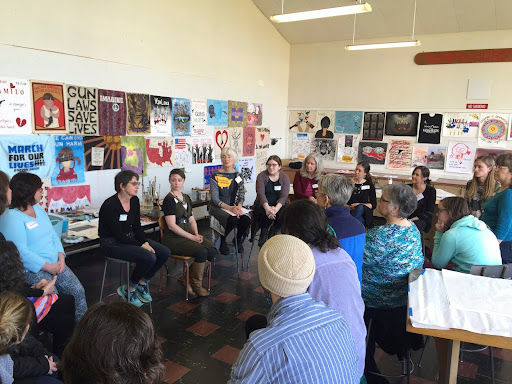
When more facilitators are trained to lead the VBV model, more communities can run meaningful sessions, host exhibitions and Community Dialogues that uplift participant voices, and sustain prevention work year after year, without losing the heart of the approach.
2. It builds local ownership and sustainability
When educators and community leaders are trained in the Visioning Beyond Violence model, the work becomes embedded in the local ecosystem. Instead of relying on outside facilitation, schools and organizations build internal capacity to lead trauma-informed dialogue, guide art-based visioning sessions, and host community exhibitions that uplift participant voices.
This shifts prevention from a one-time event into a long-term strategy. Communities can continue the work year after year, adapt it to local needs, and deepen impact as more facilitators are trained and supported.
We have seen this model become locally owned when schools and partners build internal facilitation capacity. At Lighthouse Community Public Schools in Oakland, teachers and staff are working together to bring this experience to 150 eighth graders this year. At Lewis & Clark College, art therapy graduate students and faculty have been trained in the VBV approach and have supported high school students at Parkrose High School, expanding the reach of healing-centered, art-based prevention through a local partnership.
3. VBV Training strengthens the network of community healing
Training does more than teach a workshop format. It builds a shared language of healing-centered facilitation, community dialogue, and creative expression as a tool for prevention.
Over time, trained facilitators become a connected network across schools, nonprofits, and community organizations. That network increases collaboration, strengthens consistency in how the work is held, and accelerates collective impact as communities learn from one another and share what works. VBV artworks are worn in vigils and marches and used to advocate to local and state lawmakers to bring attention and funding to community prevention needs.
Why the “how” of training matters
Gun violence prevention work is sensitive, urgent, and deeply personal for many students and community members. A poorly facilitated conversation can retraumatize. A well-facilitated one can build safety, connection, and agency.
VBV facilitator training emphasizes:
Creating emotionally safe learning spaces
Using consistent check-ins and reflection
Recognizing when participants need additional support and knowing what to do next
Centering hope, dignity, and agency
Closing heavy conversations with grounding, creative expression, and action steps
Art-based training expands hope across communities
One of the most powerful aspects of the Visioning Beyond Violence model is the art-making

process, in which participants create 18 x 24-inch panels that express their vision for safety, healing, and the end of gun violence. When educators and community leaders are trained to facilitate this process with care, the impact goes beyond the workshop. Youth and community members gain:
A safe outlet for grief and reflection
A public platform for their voice
A tangible artifact of their agency
A way to engage their community in dialogue
Over time, these artworks become part of a broader movement, connecting stories and visions across communities.
What safer communities gain from a training model
When violence prevention organizations invest in facilitator training, communities gain more than a one-time workshop. They build local capacity to lead healing-centered dialogue and art-based visioning with consistency and care:
More youth and community members have access to trauma-informed spaces to process and reflect
More educators and facilitators feel confident holding difficult conversations safely
More public exhibits and community sharings spark dialogue, awareness, and connection
More participants believe change is possible because they can see and name their own agency
More communities shift from isolation and fear toward shared understanding and collective action
Training facilitators does not just multiply program delivery; it also improves it. It multiplies leadership, empathy, and civic engagement, and it helps communities sustain prevention work over time.
Amplifying solutions for safer communities

The future of violence prevention depends on scalable, sustainable models that empower local leaders.
By investing in Visioning Beyond Violence facilitator training, organizations are not simply expanding programs. They are building a distributed network of trained facilitators who can guide youth and communities through healing-centered dialogue, creative expression, and collective visioning for safer communities.
If you are ready to support this work:
👉 Book a consultation for training (for schools and organizations)👉 Support the work with a donation (for individual supporters)👉 Explore the Virtual Art Gallery👉 Review impact outcomes👉 Partner with us
Because when we equip communities to lead, prevention stops being isolated work. It becomes a movement.

Comments